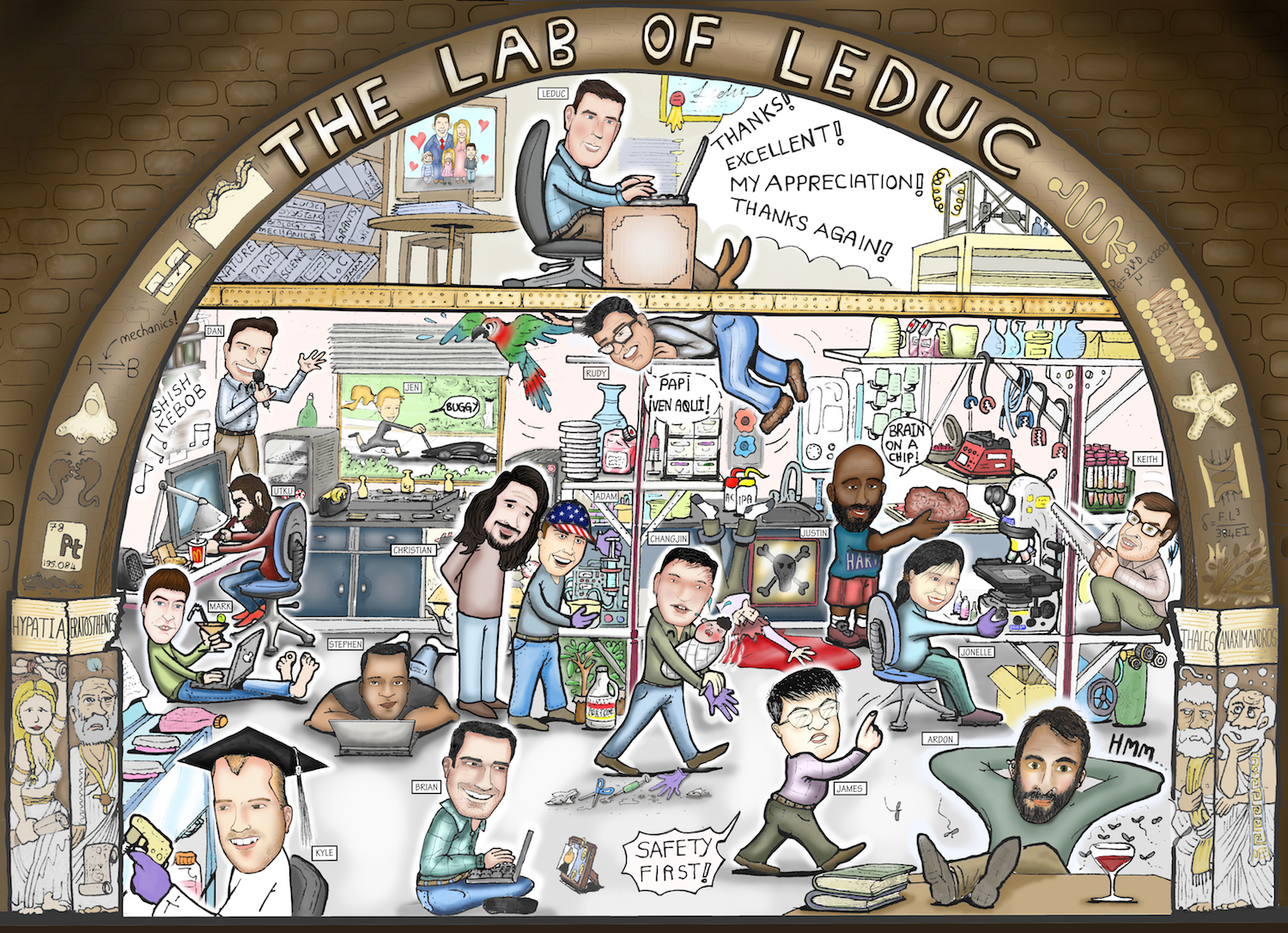
The LeDuc Lab

The LeDuc Lab has been interfacing technology and modeling with biology and medicine for over two decades. The lab works on where the mechanics of machines and the wonders of nature intersect. While the lab members have come from a variety of backgrounds (mechanical engineering, biology, chemical engineering, material science, physics, computer engineering, biomedical engineering, chemistry, electrical engineering, etc.), the lab approaches this intersection by envisioning cells and molecules as systems that can be investigated with some of the same fundamental approaches used on machines such as planes and automobiles looking for unifying principles. These systems range from mammalian cell to microorganism to organisms (e.g. mammalian cells, magnetic bacteria, energy generating bacteria, Xenopus laevis, ghost crabs, plants) and applies principles from mechanical engineering fields (e.g. solid mechanics, control theory, fluidics, heat transfer, design, etc.) to understand how these principles may apply across diverse nature based systems. They also work on linking mechanics to biochemistry at the cellular and molecular levels through examining structural regulation as well as on novel approaches to technology development through focusing on nature inspired design principles at the molecular and cellular levels. They pursue  these goals through developing and utilizing nanotechnology, microtechnology, computational biology, control-feedback theory, etc. as well as a strong interest in building new systems from the knowledge that we obtain in a similar thought process as we use to build a new machine. By combining novel approaches through engineering and biotechnology as well as translating this exciting technology to entrepreneurial products, this multidisciplinary research can make a huge impact to the studies of human health and diseases. The LeDuc Lab appreciates the kind funding from many different organizations to pursue these directions including the Beckman Young Investigator-2nd CMU professor to win, NSF-CAREER, Gates Foundation-2nd CMU professor to win, NIH, NSF, Heinz, Sloan Foundation, DOE, ONR, AFOSR, ARPA-H).

Focus areas

Research in The LeDuc Lab falls into four main areas: 

Experimental Cellular and Molecular Mechanics
One of my contributions to science is in linking mechanics to biochemistry through structural regulation and mechanotransduction. We have developed a lab with special capabilities so that we can conduct these types of experiments ranging from stretchable systems, magnetic needles, robotic approaches, etc. These approaches have allowed us to make contributions to understanding key mechanotransduction proteins as well as how mechanically related materials affect cell response (PNAS, Nature Nanotechnology, Experimental Mechanics, Langmuir, Nature Protocols, Nature).


Artificial Intelligence/Machine Learning in Biology and Medicine
Another of my contributions to science is implementing computational methods to medicine and biology, which I have been doing for over 2 decades. We have implemented artificial intelligence and machine learning on a range of areas including medical data classification (e.g., small-dataset classification) and probabilistic / AI-informed design methods in engineering systems applied to biology and medicine (Nature Digital Medicine, Advanced Intelligent Systems, PlosOne, The American Journal of Pathology).


Cellular and Molecular Inspired Approaches and Principles through Microfabrication
Another important part of my work is to develop new methods for investigating biological systems. We have developed microfabrication-based approaches that have allowed us to examine collective migration to mechanochemical responses in multicellular systems, as well as artificial cells and synthetic biology. These systems are created through soft lithography as well as new developed fabrication methods including new 3D printing approaches (Nature Nanotechnology, PNAS, Applied Physics Letters, JACS, Advanced Materials, Nano Letters, Science Robotics, Nature).


Investigating Non-Human Biological and Nature Inspired Systems with Integrated Technology and Robotics
Our lab has been working in the area of non-human biological as well as bioinspired systems due to our interest in the diverse and robust functional responses in nature. We have developed approaches to help understand and interface with microorganisms in areas ranging from bioelectric energy to magnetically controlled systems for influencing microorganism movement. We have also investigated Nature inspired directions such as bioinspired solar energy, ghost crabs response, extinct creature movement, and plant mechanics and technology (PNAS, Nature Communications, Science Robotics, Advanced Science, Annu. Rev. Biomed. Eng., Renewable and Sustainable Energy Reviews).

The LeDuc Lab also founded the Center for the Mechanics and Engineering of Cellular Systems (CMECS) at CMU including over 20 faculty members from engineering, biology, chemistry, physics, and computer science, with the goal of using mechanical engineering with cellular systems to address biological problems ranging from disease to bioenergy to malnutrition in third-world countries.
▲ Back to the top

Faculty

LeDuc headshot

Phil LeDuc

Professor, Mechanical Engineering

Philip LeDuc is the William J. Brown Professor in the Department of Mechanical Engineering. In his lab, he works at the intersection of mechanical engineering and biology by envisioning cells and molecules as systems that can be investigated with some of the same fundamental approaches used on machines such as planes and automobiles looking for unifying principles. These systems range from mammalian cells to microorganisms to developmental biology systems and apply principles from mechanical engineering fields to understand how these principles may apply across diverse nature-based systems.

His lab conducts basic science and applied research in crossing over mechanical engineering approaches including solid mechanics, fluid mechanics, control theory, etc. with biological systems ranging from algae to artificial cells to developmental biology.

He has received the National Science Foundation CAREER award, George Tallman Ladd Research Award, Russell V. Trader Career Faculty Fellow, Benjamin Richard Teare Teaching Award, “Professor of the Year” as voted by the senior class, MARC Minority Faculty Mentor Award, and Beckman Foundation Young Investigator Award. He is a member of the National Research Council Roundtable on Biomedical Engineering Materials and Applications (BEMA), and a Fellow of the Biomedical Engineering Society, American Society of Mechanical Engineers, the American Institute for Medical & Biological Engineering, and the International Academy of Medical and Biological Engineering (IAMBE).

Office
214 Scaife Hall
Phone
412.268.3348
Email
prl@andrew.cmu.edu
Google Scholar
Phil LeDuc
▲ Back to the top

Research team

Moaiad Alabbasi

Moaiad Alabbasi

Doctorate

Co-Advisor
Shawn Litster
Research interests
Moaiad graduated from King Abdulaziz University with a Bachelor of Science in Nuclear Engineering degree in 2017. Then, he had several training programs in a different organizations within the field of nuclear technology which lasted for 2.5 years. Moreover, the training equipped him with the knowledge to allowed him to work as a nuclear safety specialist for the Saudi Nuclear and Radiological Regulatory Commission for 3 years. After that, he decided to join Carnegie Mellon University to start his Master's study under the supervision of Professor Leduc. Afterward, he started his Ph.D. Fall 2024 and co-advised by Professor Leduc and Professor Shawn. His area of interest is computational analysis for water electrolysis technology.
Email
malabbas@andrew.cmu.edu
Michelle Chang

Michelle Chang

Doctorate

Co-Advisors
Carmel Majidi
Scott Hudson
Research interests
Michelle is a PhD student at the Robotics Institute, working at the intersection of computational fabrication, unconventional materials, and HCI. She graduated from UC Berkeley with a B.S. in EECS and spent several years as a software engineer at Google before returning to academia in 2023. She also holds an M.S. in Human-Centered Design and Engineering from the University of Washington in Seattle. Her research focuses on applying computational techniques to agentic or otherwise unruly materials (e.g., liquid metal, plants) to enable novel interactive interfaces, modes of creative expression, and nature understanding. She currently works on batteryless microfluidic sensors and is passionate about living information systems, human-nature interaction, and ecologically-centered design paradigms.
David Quinn

David Quinn

Research Scientist

Research interests
Dr. David J. Quinn is a Research Scientist in the Department of Mechanical Engineering at Carnegie Mellon University (CMU), where he leverages his extensive experience in experimental and computational mechanics to advance the fields of robotics, AI, and biomedicine. An accomplished R&D leader with over 15 years of experience driving innovation across academia and industry, Dr. Quinn has previously held several executive and strategic leadership roles at CMU, including Assistant Vice President for Strategic Research Initiatives and Strategic Advisor to the Vice President for Research. He earned his Ph.D. and S.M. in Mechanical Engineering from the Massachusetts Institute of Technology (MIT), an M.Phil. from the University of Cambridge as a Gates Cambridge and Fulbright Scholar, and his B.S. in Mechanical Engineering from Villanova University. He also recently completed graduate coursework in AI and an AI engineering certificate program at CMU. At CMU, he leads and collaborates with faculty and graduate students on issues of experimental design, verification, and validation while translating complex scientific research into practical, interdisciplinary solutions.
Email
djquinn@andrew.cmu.edu
Ethan Napolitan

Ethan Napolitan

Doctorate

Co-Advisor
Carmel Majidi
Research interests
Ethan Napolitan graduated from the University of Pittsburgh in 2026 with a B.S. in Mechanical Engineering and a minor in Electrical Engineering. While at Pitt, he served as a teaching assistant for several semesters, supporting first-year engineering students in learning MATLAB and C++. Additionally, he gained research experience in Dr. Nikhil Bajaj’s Nonlinear Dynamics Laboratory and Dr. Patrick Smolinski’s Orthopaedic Engineering and Sports Medicine Laboratory. Now a PhD student co-advised by Dr. Philip LeDuc and Dr. Carmel Majidi at Carnegie Mellon University, his research focuses on soft robotics, bio-inspired engineering, and cellular/tissue mechanics. Having earned a SMART Fellowship, he plans to join NAVSEA Philadelphia as a civilian engineer following his graduation from CMU.
Email
ejnapoli@andrew.cmu.edu
James Votruba-Drzal

James Votruba-Drzal

Doctorate

Co-Advisor
Burak Ozdoganlar
Research interests
James Votruba-Drzal graduated from the University of Pennsylvania earning his B.E. in materials science and engineering. During his undergraduate studies, he worked with Professor Karen Winey, studying the use of dehydrogenation/functionalization strategies to turn waste polyolefins into higher-value materials. James started his Ph.D. program in Mechanical Engineering (Carnegie Mellon University, 2025), working on the ARPA-H LIVE liver printing project, where he’s using camphene-ice printing to fabricate artificial liver lobules.
Email
jtv@andrew.cmu.edu
Alex Naglich

Alex Naglich

Doctorate

Research interests
Alex graduated from Montana State University (MSU) in 2021 with a B.E. in Mechanical Engineering. During his undergraduate studies, he developed a passion for teaching and tutoring, aspiring to a future professorship. After graduating, he worked at MSU's Imaging and Chemical Analysis Laboratory (ICAL) as a Lab Technician and Research Consultant, providing crucial support to various research endeavors. Currently, Alex is pursuing a PhD in Mechanical Engineering with a Biology emphasis under Dr. Philip LeDuc, focusing on: 1) observing the behavior of the mechanically actuating and sensing Mimosa Pudica and exploring biohybrid robotics applications; 2) developing an open-source, 3D-printable syringe pump ecosystem emphasizing ease of adoption, modularity, and robust software; and 3) studying the role of mechanical stress-induced extracellular vesicle release in muscle tissue regeneration.
Email
anaglich@andrew.cmu.edu
Maria Parilli

Maria Gabriela Parilli Alvarez

Doctorate

Co-Advisors
Andrew Spielberg
Paula Marques
Pedro Fonseca
Research interests
Maria received her B.S. in Electrical Engineering from Universidad Simón Bolívar in 2022. Following her graduation, she continued her thesis work with Dr. Carlos Mastalli from Heriot-Watt University, which led to a novel optimal control algorithm. This algorithm is particularly useful for robotics simulators like Crocoddyl as it can effectively handle equality constraints. In 2024, she joined the LeDuc Lab at Carnegie Mellon University (CMU) as a Research Assistant, where she worked with the mechanical sensor using bioluminescent algae project. The following year, Maria began her CMU Portugal Dual PhD with the LeDuc Lab. She is co-advised by Professors LeDuc and Andrew Spielberg from CMU, as well as Professors Paula Marques and Pedro Fonseca from the University of Aveiro. Her research interests lie in advanced control and optimization applications.
Email
mparilli@andrew.cmu.edu
Mangalam Sahai

Mangalam Sahai

Doctorate

Co-Advisor
Jon Cagan
Research interests
Mangalam is currently a Ph.D. candidate in Mechanical Engineering at Carnegie Mellon University (CMU). His doctoral research focuses on developing unsupervised computational models for decidual vasculopathy detection, for diagnosing Preeclampsia. He is the recipient of the TCS Presidential Fellowship at CMU for 2025-26. He joined the LeDuc Lab in 2022 as a master’s student in Biomedical Engineering at CMU. Before joining masters’, he worked as a project manager in pharmaceutical drug development. During undergrad, he attended NMIMS University in Mumbai, India, where he received his B.Tech in Chemical Engineering and MBA in Technology Management in 2018. Outside the lab, Mangalam enjoys playing squash, swimming, hiking, and travelling. During leisure time, he loves playing chess and reading books.
Email
msahai@andrew.cmu.edu
Feimo Yang

Feimo Yang

Doctorate

Co-Advisor
Burak Ozdoganlar
Research interests
Feimo received his B.S. in Mechanical Engineering from University of Texas at Arlington (UTA) in 2019, and his M.S. in Mechanical Engineering from Texas A&M University (TAMU) in 2022. Prior to his undergraduate study, he served as a deputy intelligence and security (Lieutenant) officer in Singapore Armed Force (SAF) in 2015. He is passionate about additive manufacturing and anything related thereto. During his time in TAMU, he worked in Manufacturing Innovation Laboratory (MI-Lab) on improving PDMS 3D printing and implementing hydrogel resin films. He started his Ph.D. program in Carnegie Mellon University in 2022, co-advised by Professor Philip Leduc and Professor Burak Ozdoganlar. His current research interests are on artificial tissue constructs and innovative additive manufacturing.
Email
feimoy@andrew.cmu.edu
Nathan Zimmerer

Nathan Zimmerer

Doctorate

Co-Advisor
Melisa Orta Martinez
Research interests
Nathan graduated from University of Illinois at Urbana-Champaign (UIUC) in 2016 with a B.S. in Mechanical Engineering and was a recipient of the Bronze Tablet award. He went on to work as a Test Engineer from 2016 - 2020 with the Boeing Company on NASA’s SLS/Artemis program, developing qualification procedures for the thrust vector control system and providing engineering support to over 1,500 sensor installations for major structural qualification test articles. He served as a console operator to monitor critical real time data for numerous tests including a hot fire test of the core stage vehicle. From 2020 - 2022, he worked as a mechanical design engineer for Boeing’s Flight Simulation Lab in St. Louis, rapidly generating low cost designs for mechanisms to mirror physical flight systems. As a PhD student, co-advised by Dr. Philip LeDuc and Dr. Melisa Orta-Martinez, his research is focused on the intersection of biology and mechatronic systems, developing biohybrid systems with robotics applications and novel lab on chip designs capable of multi-modal cellular mechanical stimulation. He earned a NSF GRFP Honorable Mention and is currently supported both by the GEM Fellowship and the NIH TL1 Training Program.
Email
nathanz@andrew.cmu.edu
woman

Uma Sharma

Doctorate

Co-Advisor
Jessica Zhang
Research interests
Uma graduated with a B.S. in Biomedical Engineering with a minor in Computer Science from George Washington University in 2023. While at GWU she was an intern at the NIH Radiology and Imaging Sciences Department, where she first became involved with biomedical research. Uma completed her Masters in Computational Biomedical Engineering at CMU in December of 2024, and began her PhD in Mechanical Engineering in January 2025, co-advised by Dr. Philip LeDuc and Dr. Jessica Zhang. Her research interests include machine learning, computational biomodeling, and image analysis. Her current project investigates dendritic spine morphology to characterize transitional spine shapes toward developing advanced models for morphological distributions and transitions in the context of neurodegeneration.
Email
umas@andrew.cmu.edu
Andrews Arias Rosales

Andrés Arias-Rosales

Post-Doctorate

Research interests
He works on challenging interdisciplinary projects at the intersections of artificial intelligence, medicine, design, art, and renewable energy. His passion lies in creating useful tools that augment human expertise and building interdisciplinary bridges. He holds a Ph.D. in Mechanical Engineering from Carnegie Mellon University, a Specialization in AI Engineering from IBM, and graduated with highest honors from EAFIT University with an M.Sc. in Engineering and a B.A. in Product Design Engineering. As Principal AI Architect at Placenta AI, he develops deep learning algorithms to assist pathologists in diagnosing decidual vasculopathy from histological images. As a Research Scientist at Carnegie Mellon, he works with world-renowned Rembrandt expert Arthur K. Wheelock to develop AI algorithms that identify unique aspects of masterpieces. He also leads two data science research projects at EAFIT University on social barriers in renewable energy communities, and teaches AI fundamentals and applications as an Adjunct Professor at EIA University.
Email
aariasro@alumni.cmu.edu
▲ Back to the top

Recent Alumni:

  • Mark DeAngelis
  • Richard Desatnik
  • Latifah Al-Maghrabi
  • Andrés García Rubio
  • Andrés Arias-Rosales 

Publications

2024

  • Garg, A., Yang, F., Ozdoganlar, O.B.* LeDuc, P.R. * Physics of Microscale Freeform 3D Printing of Ice. Proceedings of the National Academy of Sciences 121 (30), e2322330121 (2024).
  • Naglich, A., LeDuc, P.R.* Plant Movement Response to Environmental Mechanical Stimulation Toward Understanding Predator Defense. Advanced Science 2404578 (8), (2024).
  • Sonmez, U., Frey, N., LeDuc, P.R.*, Minden, J.S.* Fly Me to the Micron: Microtechnologies for Drosophila Research. Annu. Rev. Biomed. Eng.26:441-73 (2024).

2023

  • Desatnik, R., Patterson, Z. Gorzelak, P., Zamora, S., LeDuc, P.*, Majidi, C.* Soft Robotics Informs How an Early Echinoderm Moved. Proceedings of the National Academy of Sciences 120(46): e2306580120 (2023).
  • Arias-Rosales, A.*, LeDuc, P.* Urban solar harvesting: The Importance of Diffuse Shadows in Complex Environments. Renewable and Sustainable Energy Reviews 175: 113155 (2023).
  • Beltran, S.M., Bobo, J., Habib, A., Kodavali, C.V., Edwards, L., Mamindla, P., Taylor, R.E., LeDuc, P.R.*, Zinn, P.O.* Characterization of Neural Mechanotransduction Response in Human Traumatic Brain Injury Organoid Model. Scientific Reports 13:13536 (2023).
  • DeAngelis, M., Ruder, W.*, LeDuc, P.* An embedded microfluidic valve for dynamic control of cellular communication. Applied Physics Letters 123: 244103, (2023).
  • Keeys, N., Patel, D.K., LeDuc, P.R.*, Majidi, C.* Soft Magnetic Thin Film Deformation with a Bistable Electropermanent Magnet. Eng Res Express. 5(3): 035071 (2023).
  • Kabuye, E., LeDuc, P.R.*, Cagan, J. * A Mixed Reality System Combining Augmented Reality, 3D Bio‑Printed Physical Environments and Inertial Measurement Unit Sensors For Task Planning. Virtual Reality 27: 1845–1858 (2023).
  • Wang, K., Frey, N., Garcia, A., Man, K., Yang, Y., Gualerzi, A., Clemens, Z.J., Bedoni, M., LeDuc, P.R., Ambrosio, F. Nanotopographical Cues Tune the Therapeutic Potential of Extracellular Vesicles for the Treatment of Aged Skeletal Muscle Injuries. ACS Nano 17 (20): 19640–1965 (2023).
  • Won, P., Coyle, S., Ko, S.H., Quinn, D., Hsia, K.J., LeDuc, P.R., Majidi, C. Controlling C2C12 Cytotoxicity on Liquid Metal Embedded Elastomer. Adv. Healthcare Mater. 12: 2202430 (2023).

2022

  • Frey, N., Sonmez, U., Minden, J.S.*, LeDuc, P.R.* Microtechnologies for Understanding and Engineering Model Biological Organisms. Nature Communications 13: 3195, DOI: 10.1038/s41467-022-30814-6 (2022).
  • Arias-Rosales, A., LeDuc, P.* Shadow Modeling in Urban Environments for Solar Harvesting Devices with Freely Defined Positions and Orientations. Renewable and Sustainable Energy Reviews 164: 112522 (17) (2022).
  • Garg, A., S. Yerneni, S.S., Campbell, P., LeDuc, P.R. *, & Ozdoganlar, O.B.* Freeform 3D Ice Printing (3D-ICE) at the Micro Scale. Advanced Science. 2201566 (11), (2022).
  • Whiting, M., Novellic, E.M., Mettenburg, J., LeDuc, P.R.*, Cagan, J. * Inducing Vascular Grammars for Anomaly Classification in Brain Angiograms. ASME Journal of Engineering and Science in Medical Diagnostics and Therapy. 1: 5(2):021002 (2022).
  • Coyle, S., Doss, B., Huo, Y., Singh, H.R., Quinn, D., Hsia, K.J., LeDuc, P.R.* Cell Alignment Modulated by Surface Nano-topography - Roles of Cell-Matrix and Cell-Cell Interactions, Acta Biomaterialia 142 (1): 149-159 (2022).
  • Kabuye, E., Hellebrekers, T., Bobo, J., Keeys, N., Majidi, C., Cagan, J. *, LeDuc, P.R.* Tracking of Scalpel Motions with an Inertial Measurement Unit System IEEE Sensors 22, 5(1): 4651 – 4660 (2022).

2021


  • Wan, L., Yin, J., Skoko, J., Schwartz, R., Zhang, M., LeDuc, P.R.*, Neumann, C.* 3D Collagen Vascular Tumor-On-A-Chip Mimetics for Dynamic Combinatorial Drug Screening. Mol Cancer Ther. 20(6): 1210-1219 (2021).
  • Torres, R., Yuan, R., Kowalewski, T., Matyjaszewski, K., LeDuc, P.*, Litster, S.* Fe-Doped Copolymer-Templated Nitrogen-Rich Carbon as a PGM-Free Fuel Cell Catalyst. ACS Appl. Energy Mater. 4 (9): 9653-9663 (2021).
  • Wood, A.R., Garg, R., Justus, K., Cohen-Karni, T., Alan J. Russell, A.J.*, LeDuc, P.R.* Toward Sustainable Desalination Using Food Waste. RSC Adv. 11: 9628-9637 (2021).


2020


  • Clymer, D.R., Kostadinov, S., Catov, J., Skvarca, L., Pantanowitz, L., Cagan, J. *, LeDuc, P.* Decidual Vasculopathy Identification in Whole slide Images Using Multi-Resolution Hierarchical Convolutional Neural Networks. The American Journal of Pathology 190 (10): 2111 (2020).
  • Sonmez, U.M., Coyle, S., Taylor, R.E., LeDuc, P.R.* Polycarbonate Heat Molding for Soft Lithography. Small 16: 2000241 (2020).
  • Arias-Rosales, A., & LeDuc, P. R. Modeling the transmittance of anisotropic diffuse radiation towards estimating energy losses in solar panel coverings. Applied Energy 268 (2020): 114872.
  • Wan, L., Neumann, C.*, LeDuc, P.R.* Tumor on a Chip for Integrating A 3D Tumo Microenvironment: Mechanical, Chemical, and Oxygen Factors. Lab on a Chip 20: 873-888 (2020).
  • Bobo, J., Garg, A., Venkatraman, P., Puthenveedu, M., LeDuc, P.R.* 3D In Vitro Neuron on a Chip for Probing Calcium Mechanostimulation. Advanced Biosystems. 4: 2000080 (2020).
  • Yeh, R.Y., Nischal, K.K., LeDuc, P.R.*, Cagan, J.*, Written in Blood: Applying Shape Grammars to Retinal Vasculatures. Translational Vision Science and Technology 9(9):36 (2020).
  • Wan, L., Flegle, J., Ozdoganlar, B., LeDuc, P.R.*, Toward Vasculature In Skeletal Muscle-On-A-Chip Through Themoresponsive Sacrificial Templates. Micromachines 11: 907 (2020).
  • Chou, S.Y., Lin, C.-Y., Cassino, T., Wan, L., LeDuc, P.R.* Probing Coordinated Coculture Cancer Related Motility through Differential Micro-compartmentalized Elastic Substrates" Scientific Reports (Nature Publishing Group). 10: 18519 (2020).
  • Bone, J.M., Childs, C.M., Menon, A., Póczos, B., Feinberg, A.W., LeDuc, P.R., Washburn, N.R., Hierarchical Machine Learning for High-fidelity 3D Printed Biopolymers ACS Biomater. Sci. Eng. 6: 7021?7031 (2020).
  • Arias-Rosales, A., & LeDuc, P. R. Comparing View Factor modeling frameworks for the estimation of incident solar energy. Applied Energy 277 (2020): 115510.
  • Clymer, D.R., Long, J., Latona, C., Akhavan, S., LeDuc, P.*, Cagan, J.* Applying Machine Learning Methods toward Classification based on Small Datasets: Application to Shoulder Labral Tears. Journal of Engineering and Science in Medical Diagnostics and Therapy 3: 011004-1 (2020).
  • Sonmez, U., Justus, K., Jiang, W., LeDuc, P.R.*, Kalinski, P. *, Davidson, L.A. Chemotactic Responses of Immune Cells in Microfluidic Flow-free Gradient Chambers. Micromachines 11: 384 (2020).


2010s

  • Justus, K.B., Lewis, D., Majidi, C.*, LeDuc, P.R.,*, Tan, C.* A Biosensing Soft Robot: Integrating Chemical and Optical Responsive Synthetic Cells with Soft Robotics. Science Robotics 4: eaax0765 (2019).
  • Shorr, A.Z., S.nmez, U., Minden, J.S.*, LeDuc, P.R.* High-throughput Mechanotransduction in Drosophila Embryos with Mesofluidics. Lab on a Chip 19: 1141-1152 (2019, cover).
  • Wood, A.R., Garg, R., Justus, K., Cohen-Karni, T., LeDuc, P.R.*, Alan J. Russell, A.J.* Intact Mangrove Root Electrodes for Desalination. RSC Advances 9: 4735-4743 (2019).
  • Coyle, S., Majidi., C., LeDuc. P., Hsia. K.J. Bio-inspired Soft Robotics: Material Selection, Actuation, and Design. Extreme Mechanics Letters 22: 51–59 (2018).
  • Whiting, M., Cagan, J. *, LeDuc, P.R.* Efficient Probabilistic Grammar Induction for Design. Journal of Artificial Intelligence for Engineering Design, Analysis and Manufacturing 32: 177–188 (2018).
  • Whiting, M., Cagan, J. *, LeDuc, P.R.* Efficient Probabilistic Grammar Induction for Design. Journal of Artificial Intelligence for Engineering Design, Analysis and Manufacturing: AI EDAM 32.2 (2018): 177.
  • Wan, L., Skoko, J., Yu, J., LeDuc, P.R.* Neumann, C,* Mimicking Embedded Vasculature Structure for 3D Cancer on a Chip Approaches through Micromilling. Scientific Reports (Nature Publishing Group) 7: 16724 (2017).
  • Egan, P., Moore, J., Ehrlicher, A., Weitz, D., Schunn, C.*, Cagan, J.*, LeDuc, P.* Robust Mechanobiological Behavior Emerges in Heterogeneous Myosin Systems. Proceedings of the National Academy of Sciences 114: E8147-E8154 (2017).
  • Naserifar, N., LeDuc, P.R.*, Fedder, G.K.* Drop Casting of Stiffness Gradients for Chip Integration into Stretchable Substrates. Journal of Micromechanics and Microengineering 27: 045018 (2017).
  • Jonelle, J. Y., Korkmaz, E., LeDuc, P.R.*, Ozdoganlar, O., B.* Biomimetic Scaffolds with Three-dimensional Undulated Micro-Topographies. Biomaterials 128: 109-120 (2017).
  • Naserifar, N., LeDuc, P.*, Fedder, G.K.* Material Gradients in Stretchable Substrates toward Integrated Electronic Functionality Advanced Materials 28:3584-91(2016).
  • Egan, P., Cagan, J.*, Schunn, C.*, Chiu, F., Moore, J., LeDuc, P.* The D3 Methodology: Bridging Science and Design for Bio-Based Product Development. Journal of Mechanical Design 138: 081101 (13), (2016).
  • Warren, K.M, Mpagazehe, J.N., LeDuc, P.R.* and Higgs, C.F.* Geometric Effects in Microfluidics on Heterogeneous cell stress using an Eulerian–Lagrangian approach. Lab Chip 16: 593-598 (2016).
  • Warren, K.M, Islam, M.M., LeDuc, P.R.*, Steward, R.* 2D and 3D Mechanobiology in Human and Nonhuman Systems. ACS Appl. Mater. Interfaces 8: 21869-21882 (2016).
  • Egan, P., Schunn, C.*, Cagan, J.*, LeDuc, P.* Improving Understanding and Design Proficiency of Complex Multi-level Biosystems Through Animation and Parametric Relationships Support" Design Science 1, e3 doi:10.1017/dsj.2015.3 (2016).
  • Egan, P., Sinko, R., LeDuc, P.R.*, Keten, S.* The Role of Mechanics in Biological and Bio-Inspired Systems. Nature Communications 6: 7418, DOI: 10.1038/ncomms8418 (2015).
  • Egan, P., Moore, J., Schunn, C.*, Cagan, J,*, LeDuc, P.* (2015) Emergent Systems Energy Laws for Predicting Myosin Ensemble Processivity. PLoS Computational Biology 11(4): e1004177. (2015)
  • Kang, J., Puskar, K.M., Ehrlicher, A.J., LeDuc, P.R., Schwartz, R.S. Structurally Governed Cell Mechanotransduction through Multiscale Modeling. Scientific Reports 5: 8622, DOI: 10.1038/srep08622 (2015).
  • Egan, P., Cagan, J,*, Schunn, C.*, LeDuc, P.* Synergistic Human-Agent Methods for Deriving Effective Search Strategies: The Case of Nanoscale Design. Research in Engineering Design 26:145-169 (2015)
  • Hazar, M., Kim, Y.T., Song, J., LeDuc, P.R.* Davidson, L.A.*, Messner, W.C.* 3D Bio-Etching of a Complex Composite-Like Embryonic Tissue. Lab-on-a-Chip 15: 3293-3299 (2015).
  • Song, J., Shawky, J.H., Kim, Y.T., Hazar, M., LeDuc, P.R.* Sitti, M.*, Davidson, L.A.*, Controlled Surface Topography regulates Collective 3D Migration by Epithelial-Mesenchymal Composite Embryonic Tissues. Biomaterials 58:1-9 (2015)
  • Steward, R.L., Tan, C., Cheng, C.M., LeDuc, P.R.* Cellular Force Signal Integration Through Vector Logic Gates. J Biomech. 48:613-620 (2015).
  • González, L.M., Ruder, W.C., Mitchell, A.P., Messner, W.C., * LeDuc, P.R. * Sudden Motility Reversal Indicates Sensing of Magnetic Field Gradients in Magnetospirillum magneticum AMB-1 strain. The ISME Journal-Nature Publishing Group 9:1399-1409 (2015)
  • Kim, Y.T., Hazar, M., Vijayraghavan, D., Song, J., Messner, W.C.*, Davidson, L.A.*, LeDuc, P.R.* Mechanochemical Actuators of Embryonic Epithelial Contractility. Proceedings of the National Academy of Sciences 111.40 (2014): 14366-14371.
  • Sei, Y., Justus, K., LeDuc, P.R.*, Kim, Y.T.* Engineering Living Systems on Chips: From Cells to Human on Chips. Microfluidics and Nanofluidics 16, 907-920 (2014).
  • Gonzalez, L.M. Ruder, W.C., LeDuc, P.R.*, Messner, W.C.* Controlling Magnetotactic Bacteria through an Integrated Nanofabricated Metallic Island and Optical Microscope Approach.Scientific Reports 4, 4104 (2014).
  • Tan, C., Saurabh, S., Bruchez, M., Schwartz, R.*, LeDuc, P.R.* Molecular Crowding Shapes Gene Expression in Synthetic Cellular Nanosystems. Nature Nanotechnology 8, 602-608 (Cover, 2013).
  • Cheng, C.M., Kim, Y.T., LeDuc, P.R. Probing the Dynamic Responses of Individual Actin Filaments Under Fluidic Mechanical Stimulation via Microfluidics. Applied Physics Letters 102, 193704 (2013).
  • Kim, Y. T.*, LeDuc, P. R.*, & Messner, W. C.* Modeling and Control of a Nonlinear Mechanism for High Performance Microfluidic Systems. IEEE Transactions on Control Systems Technology: a Publication of the IEEE Control Systems Society 21, 203-211 (2013).
  • Egan, P.F., Cagan, J.*, Schunn, C.*, LeDuc, P.R.* Design Of Complex Biologically-Based Nanoscale Systems using Multi-Agent Simulations and Structure-Behavior-Function Representations. Journal of Mechanical Design 135 (6), 061005 (2013).
  • Ruder, W.C.*, LeDuc, P.R.* Cells Gain Traction in 3D. Proceedings of the National Academy of Sciences109, 11060-11061 (2012).
  • Tan, C., Lo, J., LeDuc, P.R.*, Cheng, C.-M.* Frontiers of Optofluidics in Synthetic Biology. Lab Chip 12, 3654-3665 (2012).
  • Kim, Y. T., Messner, W. C.* & LeDuc, P. R.* Disruptive Microfluidics: From Life Sciences to World Health to Energy. Disruptive Science and Technology 1: 41-53 (2012).
  • Ruder, W.C., Pratt, E.D., Brandy, N.Z.D., LaVan, D., LeDuc, P.R.*, &Antaki, J.A.* Calcium Signaling is Gated by a Mechanical Threshold in Three-Dimensional Environments. Scientific Reports 2, 554 (2012).
  • Didier, J.E., Schafer, C.M., & LeDuc, P.R.* Programmed Biologically Inspired Synthetic Templating of Multifunctional Nanoarchitectures for Small-Scale Reactions. European Journal of Inorganic Chemistry32, 5405-5410 (2012).
  • Lee, B., LeDuc, P.R., Schwartz, R. Three-Dimensional Stochastic Off-Lattice Model of Binding Chemistry in Crowded Environments. PLoS One 7, e30131 (2012).
  • Cassino, T.R., Drowley, L. Okada, M., Beckman, S.A., Keller, B., Tobita, K., LeDuc, P.R. & Huard, J. Mechanical Loading of Stem Cells for Improvement of Transplantation Outcome in a Model of Acute Myocardial Infarction: The Role of Loading History. Tissue Engineering Part A. 18, 1101-1108 (2012).
  • Ruder, W.C., Pratt, E.D., Bakhru, S., Sitti. M., Zappe, S., Cheng, C.M., Antaki, J.A.*, & LeDuc, P.R.* Three-Dimensional Microfiber Devices that Mimic Physiological Environments to Probe Cell Mechanics and Signaling. Lab Chip, 12, 1775-1779 (2012).
  • Ruder, W.C., Chia-Pei, D.H., Edelman, B.D., Schwartz, R.*, & LeDuc, P.R.* Biological Colloid Engineering: Self-Assembly of Dipolar Ferromagnetic Chains in a Functionalized Biogenic Ferrofluid. Appl. Phys. Lett. 101, 063701 (2012).
  • LeDuc, P.R.*, Messner, W.C.,* & Wikswo, J.P.* How Do Control-Based Approaches Enter into Biology? Annual Reviews of Biomedical Engineering 13, 369-396 (2011).
  • Kim, Y, Joshi, S.D., Messner, W.C.*, LeDuc, P.R.,* & Davidson, L.A.* Detection of Dynamic Spatiotemporal Response to Periodic Chemical Stimulation in a Xenopus Embryonic Tissue. PLoS ONE 6(1), e14624 (2011).
  • Li, Z., Zhang, Y., LeDuc, P.R., & Gregory, K.B. Microbial Electricity Generation via Microfluidic Flow Control. Biotechnology and Bioengineering 108, 2061-2069 (2011).
  • Zeng, Y., Lai, T., Koh, C., LeDuc, P. R.*, & Chiam, K. H.* Investigating Circular Dorsal Ruffles through Varying Substrate Stiffness and Mathematical Modeling. Biophysical Journal, 101, 2122-2130 (2011).
  • Kim, Y, Joshi, S.D., Davidson, L.A., LeDuc, P.R.,* & Messner, W.C.* Dynamic Control of 3D Chemical Profiles with a Single 2D Microfluidic Platform. Lab on a Chip 11, 2182-2188 (2011).
  • Wilson, M.E., Kota, N. Kim, Y., Wang, Y. Stolz, D., LeDuc, P.R. *, & Ozdoganlar, O.B.*, Fabrication of Circular Microfluidic Channels by Combining Mechanical Micromilling and Soft Lithography. Lab on a Chip 11, 1550-1555 (2011).
  • Cheng, C.-M., Dawson, J.T., Guo, Q., LeDuc, P.R.*, & Li, B.* Maskless fabrication of small-scale structures through controlling phase interactions. Applied Physics A 102, 185-188 (2011).
  • Kang, J., Steward, R.L., Kim, Y.T., Schwartz, R., LeDuc, P.R., Puskar, K.M., Response of an Actin Filament Network Model under Cyclic Stretching through a Coarse Grained Monte Carlo Approach. Journal of Theoretical Biology 274, 109-119 (2011).
  • Cheng, C.-M., LeDuc, P.R. Lin, Y.-W. Localized Bimodal Response of Neurite Extensions and Structural Proteins in Dorsal-Root Ganglion Neurons with Controlled Polydimethylsiloxane Substrate Stiffness. Journal of Biomechanics 44, 856-862 (2011).
  • Lee, B., LeDuc, P.R., Schwartz, R. Unified Regression Model of Binding Equilibria in Crowded Environments. Scientific Reports (Nature Publishing group) 1, 97 (2011).
  • Hazar, M., Steward, R. L., Chang, C. J., Orndoff, C. J., Zeng, Y., Ho, M. S., LeDuc, P. R., & Cheng, C. M.* Modulating Material Interfaces Through Biologically-inspired Intermediates. Applied Physics Letters, 99, 233701 (3) (2011).
  • Steward, R. L., Cheng, C. M., Ye, J. D., Bellin, R. M., & LeDuc, P. R.* Mechanical stretch and shear flow induced reorganization and recruitment of fibronectin in fibroblasts. Scientific Reports (Nature Publishing Group), 1(147), 1-12 (2011).
  • Chou, S., Cheng, C.-M., Lin, Y. W., Chen, C.-C.*, & LeDuc, P. R.* Localized Neurite Outgrowth Sensing through Micro-patterned Elastic Substrates. Soft Matter, 21, 9871-9877(2011).
  • Ruder, W.C.*, LeDuc, P.R.* Bioinspirations: Cell-Inspired Small-Scale Systems for Enabling Studies in Experimental Biomechanics. Integrative and Comparative Biology (Former journal name: American Zoologist) 51(1), 128-132 (2011).
  • LeDuc, P.R.*, Messner, W.C.,* & & Wikswo, J.P.* How Do Controls Approaches Enter Into Biology? Annual review of biomedical engineering 13 (2011): 369-396.
  • Kim, Y, Joshi, S.D., Messner, W.C.*, LeDuc, P.R.,* Davidson, L.A.* Detection of Dynamic Spatiotemporal Response to Periodic Chemical Stimulation in a Xenopus Embryonic Tissue. PloS one 6.1 (2011): e14624.
  • Wilson, M.E., Kota, N. Kim, Y., Wang, Y. Stolz, D., LeDuc, P.R.*, Ozdoganlar, O.B.*, Fabrication of Circular Microfluidic Channels by Combining Mechanical Micromilling and Soft Lithography. Lab on a Chip 11.8 (2011): 1550-1555.
  • Kang, J., Steward, R.L., Kim, Y.T., Schwartz, R., LeDuc, P.R., Puskar, K.M., Response of an Actin Filament Network Model under Cyclic Stretching through a Coarse Grained Monte Carlo Approach. Journal of theoretical biology 274.1 (2011): 109-119.
  • Cheng, C.-M., Dawson, J.T., Guo, Q., LeDuc, P.R.*, & Li, B.* Maskless fabrication of small-scale structures through controlling phase interactions. Applied Physics A 102.1 (2011): 185-188.
  • Cheng, C.-M., LeDuc, P.R. Lin, Y.-W. Localized Bimodal Response of Neurite Extensions and Structural Proteins in Dorsal-Root Ganglion Neurons with Controlled Polydimethylsiloxane Substrate Stiffness. Journal of biomechanics 44.5 (2011): 856-862.
  • Lin, Y.W., Bellin, R.M., Cheng, C.M., Steward, R., Cheng, Y.R., LeDuc, P.R.*, & Chen, C.C.,* Probing Localized Neural Mechanotransduction through Surface-Modified Elastomeric Matrices and Electrophysiology. Nature Protocols 714, 5 (4), 714-724 (2010).
  • Steward, R.L., Cheng, C.M., Wang, D.L., & LeDuc, P.R.* Probing Cell Structure Responses Through a Shear and Stretching Mechanical Stimulation Technique. Cell Biochem Biophys 56, 115-124 (2010).
  • Huang, X., Ni, J., Yan, LeDuc, P.R., Yao, J., Lin, Q. Thermally Tunable Polymer Microlenses for Biological Imaging. Journal of Microelectromechanical Systems, 19 (6), 1444-1449, (2010).
  • Singh, M., Gracio, J., LeDuc, P., Gonçalves, P., Marques, P., Gonçalves, G., Marques, F., Silva, V., Capela e Silva, F., Potes, J., Sousa, A. Integrated Biomimetic Carbon Nanotube Composites for In Vivo Systems. Nanoscale 2, 2855-2863 (2010)
  • Kim, Y.T., Pekkan, K., Messner, W.C.,* & LeDuc, P.R.* Three-Dimensional Chemical Profile Manipulation Using Two-Dimensional Autonomous Microfluidic Control. Journal of the American Chemical Society (JACS) 132, 1339-1347 (2010).
  • Steward, R.L., Cheng, C.M., Wang, D.L., & LeDuc, P.R.* Probing Cell Structure Responses Through a Shear and Stretching Mechanical Stimulation Technique. Cell Biochem Biophys 56, 115-124 (2010).
  • Huang, X., Ni, J., Yan, LeDuc, P.R., Yao, J., Lin, Q. Thermally Tunable Polymer Microlenses for Biological Imaging. Journal of Microelectromechanical Systems, 19 (6), 1444-1449 (2010).
  • Singh, M.*, Gracio, J., LeDuc, P., Gonçalves, P., Marques, P., Gonçalves, G., Marques, F., Silva, V., Capela e Silva, F., Potes, J., Sousa, A. Integrated Biomimetic Carbon Nanotube Composites for In Vivo Systems. Nanoscale, 2, 2855-2863 (2010).
  • Kim, Y.T., Pekkan, K., Messner, W.C.*, & LeDuc, P.R.* Three-Dimensional Chemical Profile Manipulation Using Two-Dimensional Autonomous Microfluidic Control. Journal of the American Chemical Society 132, 1339-1347 (2010).
  • Cheng, C.M., Lin, Y-W, Bellin, R.M., Cheng, C.M., Steward, R., Cheng, Y.-R., LeDuc, P.R.*, & Chen, C-C* Probing Localized Neural Mechanotransduction through Surface-Modified Elastomeric Matrices and Electrophysiology. Nature Protocols 5 (4), 714-724 (2010).

2000s


  • R.M. Bellin, J.D. Kubicek, M.J. Frigault, A.J. Kamien, R. Steward Jr., H.M. Barnes, M.B. DiGiacomo, L.J. Duncan, C.K. Edgerly, E.M. Morse, C.Y. Park, J.J. Fredberg, C.M. Cheng, & P.R. LeDuc, Defining the Role of Syndecan-4 in Mechanotransduction using Surface-Modification Approaches, Proceedings of the National Academy of Sciences, 106, pp. 22102-22107, (2009).
  • S.Y. Chou, C.M. Cheng, & P.R. LeDuc+, Composite Polymer Systems with Control of Local Substrate Elasticity and Their Effect on Cytoskeletal and Morphological Characteristics of Adherent Cells, Biomaterials, 30, pp. 3136-3142, (2009).
  • Y.W. Lin, C.M. Cheng, P.R. LeDuc+, & C.C. Chen+, Understanding Sensory Nerve Mechanotransduction through Localized Elastomeric Matrix Control, PLoS ONE, 4(1), e4293, (2009).
  • J.M. Yang, J.E. Didier, T.R. Cassino, & P.R LeDuc+, Spatiotemporal Control of Apical and Basal Living Subcellular Chemical Environments through Vertical Phase Separation, Small, 5, 1984-1989, (2009).
  • S. Kumar+ & P.R. LeDuc+, Dissecting the Molecular Basis of the Mechanics of Living Cells, Experimental Mechanics, 49, pp. 11-23, (2009).
  • C.M. Cheng, Y.T. Kim, J.M. Yang, S.H. Leuba, & P.R. LeDuc+, Dynamics of Individual Polymers Using Microfluidic Based Microcurvilinear Flow, Lab on a Chip, 9, pp. 2339-2347, (2009).
  • B. Lee, P.R. LeDuc, & R. Schwartz, Parameter Effects On Binding Chemistry In Crowded Media Using A Two-Dimensional Stochastic Off-Lattice Model, Physical Review E, 80, 041918 (3), (2009).
  • C.M. Cheng, K. Matsuura, I.J. Wang, Y. Kuroda, P.R. LeDuc+ & K. Naruse+, Fabricating Small-Scale Curved Polymeric Structures with of Convex and Concave Menisci through Interfacial Free Energy Equilibrium, Lab on a Chip, 9, pp. 3306-3309, (2009).
  • S.H. Leuba, T.B. Wheeler, C.M. Cheng, P.R. LeDuc, M. Fernández-Sierra, & E. Quiñones, Structure and Dynamics of Single DNA Molecules as Manipulated by Magnetic Tweezers and or Flow, Methods, 47, pp. 214-222, (2009).
  • C.M. Cheng, R.L. Steward & P.R. LeDuc+, Probing Cell Structure by Controlling the Mechanical Environment with Cell-Substrate Interactions, Journal of Biomechanics, 42, pp. 187-192, (2009).
  • Y.T. Kim, B. Kuczenski, P.R. LeDuc+ & W.C. Messner+, Modulation of Fluidic Resistance and Capacitance for Long-Term, High-Speed Feedback Control of a Microfluidic Interface, Lab on a Chip, 9, pp. 2603-2609, (2009).
  • B. Kuczenski, W.R. Ruder, W.C. Messner+ & P.R. LeDuc+, Probing Cellular Dynamics with a Chemical Signal Generator, PLoS ONE, 4(3), e4847, (2009).
  • L. Helmick, A. Antúnez de Mayolo, Y. Zhang, C.M. Cheng, S.C. Watkins, C. Wu, & P.R. LeDuc,+ Spatiotemporal Response of Living Cell Structures in Dictyostelium discoideum with Semiconductor Quantum Dots, Nano Letters, 8, pp. 1303–1308, (2008).
  • Y. Zhang, W.C. Ruder, & P.R. LeDuc+, Artificial Cells: Building Bioinspired Systems using Small-Scale Biology, Trends in Biotechnology, 26, pp.14-20, (2008).
  • Y.L. Lu, C.M. Cheng, P.R. LeDuc+, & M.S. Ho+ Controlling the Mechanics and Nanotopography of Biocompatiable Scaffolds through Dielectrophoresis with Carbon Nanotubes, Electrophoresis, 29, pp. 3123–3127, (2008).
  • B. Lee, P.R. LeDuc, & R. Schwartz, Stochastic Off-Lattice Modeling of Molecular Self-Assembly in Crowded Environments by Green’s Function Reaction Dynamics, Physical Review E, 78, 031911 (3), (2008).
  • X. Huang, C.M. Cheng, L. Wang, B. Wang, C.C. Su, M.-S. Ho, P.R. LeDuc,+ & Q. Lin,+ Thermally Adjustable Micro lenses for Biological Imaging, Applied Physics Letters, 92, 251904 (3), (2008).
  • C.M. Cheng & P.R. LeDuc+, Creating Cellular and Molecular Patterns via Gravitational Force with Liquid Droplets, Applied Physics Letters 93, 174106 (3), (2008).
  • C.M. Cheng & P.R. LeDuc+, Structural Phase Coexistence under Reversible Thermal Control, Advanced Materials, 20, pp. 953–958, (2008).
  • *P.R. LeDuc+, M. Wong+, et al., Toward an In Vivo Biologically-Inspired Nanofactory, Nature Nanotechnology, 2, pp. 3-7, (2007).
  • Y. Zhang, C.M. Cheng, & P.R. LeDuc+, Chemically Encapsulated Structural Elements for Probing the Mechanical Responses of Biologically Inspired Systems, Langmuir, 23, pp. 8129-8134, (2007).
  • C.M. Cheng, & P.R. LeDuc+, Creating Ordered Small-Scale Biologically-Based Rods through Force-Controlled Stamping, Journal of the American Chemical Society, 129, pp. 9546-9547, (2007).
  • P.R. LeDuc+, & R. Schwartz+, Computational Models of Molecular Self-Organization in Cellular Environments, Cell Biochemistry and Biophysics, 48, pp. 16-31, (2007).
  • L. Trofin, & P.R. LeDuc+, Controlled Fabrication of Polymer Nanofibers through Template Synthesis, Journal of Applied Polymers, 105, pp. 2549-2552, (2007).
  • A. Tafazzoli, C.M. Cheng, C. Pawashe, E. Sabo, L. Trofin, M. Sitti+, & P.R. LeDuc+, Subfeature Patterning of Organic and Inorganic Materials Using Robotic Assembly, Journal of Material Research, 22, pp. 1601-1608, (2007).
  • K. Puskar, A. Parisi-Amon, S. Ta’asan, R. Schwartz, & P.R. LeDuc+, Modeling Molecular Interactions to Understand Spatial Crowding Effects on Heterodimer Formations, Physical Review E, 76, p. 041904, (2007).
  • B. Kuczenski, P.R. LeDuc+, & W.C. Messner+, Pressure Driven Spatiotemporal Control of the Laminar Fluid Interface in a Microfluidic Network, Lab on a Chip, 7, pp. 647-649, (2007).
  • *P.R. LeDuc+, & D.N. Robinson+, Using Lessons from Cellular and Molecular Structures for Future Materials, Advanced Materials, 19, pp. 3761-3770, (2007).
  • C.M. Cheng, & P.R. LeDuc+, Force-Controlled Inorganic Crystallization Lithography, Journal of the American Chemical Society, 128 (2), p. 12080, (2006).
  • C. M. Cheng, & P.R. LeDuc+, Micropatterning Polyvinyl Alcohol as a Biomimetic Material through Soft Lithography with Cell Culture, Molecular Biosystems, 2, pp. 299–304, (2006).
  • P.R. LeDuc+ & R. Bellin+, Nanoscale Intracellular Organization and Functional Architecture Mediating Cellular Behavior, Annals of Biomedical Engineering, 34, pp. 102-113, (2006).
  • C.M. Cheng, & P.R. LeDuc+, Microdrilling for Fabricating Micrometer-scale Holes in Soft Matter, Applied Physics A, 85, pp. 195-198, (2006).
  • K. Puskar, M. Kong, S. Ta’asan, R. Schwartz, & P.R. LeDuc+, Evaluating Spatial Constraints in Cellular Assembly Processes Using a Monte Carlo Approach, Cell Biochemistry and Biophysics, 45, pp. 195-202, (2006).
  • J.M. Yang, & P.R. LeDuc+, Three-Dimensional Phase Separation and Flow Patterns with Novel Multilevel Fluidics, Molecular and Cellular Biomechanics, 3, pp. 69-78, (2006).
  • C.M. Cheng, J. Kubicek, & P.R. LeDuc+, Polymeric Microlenses for Real-Time Aqueous and Non-aqueous Organic Imaging, Applied Physics Letters, 88, 053902 (3), (2006).
  • N. Shen, D. Datta, C.B. Schaffer, P.R. LeDuc, D.E. Ingber, and E. Mazur, Ablation of Cytoskeletal Filaments and Mitochondria in Live Cells Using a Femtosecond Laser Nanoscissor, Molecular and Cellular Biomechanics, 2, pp. 17-25, (2005).
  • C.M. Cheng, B. Li, and P.R. LeDuc+, Optical Fabrication of Three-Dimensional Polymeric Microstructures, Applied Physics Letters, 87, p. 164104 (3), (2005).
  • J. Kubicek, S. Brelsford, P. Ahluwalia, and P.R. LeDuc+, Integrated Lithographic Membranes and Surface Adhesion Chemistry for Three-Dimensional Cellular Stimulation, Langmuir, 20, pp. 11552-115556, (2004).
  • K. Puskar, L. Apelstein, S. Ta’asan, R. Schwartz, & P.R. LeDuc+, Understanding Actin Organization in Cell Structure through Lattice Based Monte Carlo Simulations, Molecular and Cellular Biomechanics, 1, pp. 123-132, (2004).
  • S. Takayama, E. Ostuni, P.R. LeDuc, K. Naruse, D. Ingber, & G.M. Whitesides, Selective Chemical Treatment of Cellular Microdomains Using Multiple Laminar Streams, Journal of Chemistry and Biology, 10, pp. 123-130, (2003).
  • E. Brock, C. Chang, C. Ho, P.R. LeDuc, J. Jiang, G. Whitesides, & D. Ingber, Geometric Determinants of Directional Cell Motility Revealed Using Microcontact Printing, Langmuir, 19, pp. 1611-1617, (2003).
  • X. Jiang, S. Takayama, X. Qian, E. Ostuni, H. Wu, N. Bowden, P.R. LeDuc, D.E. Ingber, and G.M. Whitesides, Controlling Mammalian Cell Spreading and Cytoskeletal Arrangement with Conveniently Fabricated Continuous Wavy Features on Poly(dimethylsiloxane), Langmuir, 18, pp. 3273-3280, (2002).
  • M. Castedo, T. Roumier, J. Blanco, K.F. Ferri, J. Barretina, L.A. Tintignac, K. Andreau, J.L. Perfettini, A. Amendola, R. Nardacci, P.R. LeDuc, D.E. Inger, S. Druillennec, B. Roques, S.A. Leibovitch, M. Vilella-Bach, J. Chen, J.A. Este, N. Modjtahedi, M. Piacentini, & G. Kroemer, Sequential involvement of Cdk1 mTOR and p53 in apoptosis induced by the HIV-1 envelope, EMBO Journal, 21, pp. 4070-4080, (2002).
  • S. Takayama, E. Ostuni, P.R. LeDuc, K. Naruse, D. Ingber, & G.M. Whitesides, Laminar Flows—Subcellular Positioning of Small Molecules, Nature, 411, p. 1016, (2001).
  • S. Takayama, E. Ostuni, X. Qian, J.C. McDonald, X. Jiang, M-H. Wu, P.R. LeDuc, D. Ingber, & G.M. Whitesides, Topographical Micropatterning of Poly (dimethylsiloxane) Using Laminar Flows of Liquids in Capillaries, Advanced Materials, 13, pp. 570-577, (2001).
  • P.R. LeDuc, E.M. Whiteley, G. Bao, & M.J. Betenbaugh, Investigating the Secretion Pathway Using a Secretable Green Fluorescent Protein, Biotechnology Progress, 16, pp. 716-723, (2000).
  • K.F. Ferri, E. Jacotot, P.R. LeDuc, M. Geuskens, D.E. Ingber, & G. Kroemer, Apoptosis of Syncytia Induced by HIV-1-ENV/CD4 Interaction, Influence of Cell Shape and Size, Experimental Cell Research, 261, pp. 119-126, (2000).


1990s

  • P.R. LeDuc, C. Haber, G. Bao, and D. Wirtz, Dynamics of Individual Flexible Polymers in a Shear Flow, Nature, 399, pp. 564-566, (1999).
  • P.R. LeDuc & G. Bao, Thermal Softening of a Particle-Modified Tungsten-Based Composite under Adiabatic Compression, International Journal of Solids and Structures, 34, pp. 1563-1581, (1997).

▲ Back to the top

Connect with us:

LinkedIn

X

Instagram