How spinal cord stimulation helps to restore arm movement after stroke
Kaitlyn Landram
Jul 17, 2026
Researchers in the Neuromechatronics Lab at Carnegie Mellon University have already proven that spinal cord stimulation can help people regain movement after stroke, but until now they didn’t quite know how.
In a new study, published today in Cell Reports Medicine, a research team led by Doug Weber, Professor of Mechanical Engineering and Neuroscience, and PhD Candidate, Luigi Borda report that epidural spinal cord stimulation works by restoring inhibitory spinal circuits. These circuits enable the nervous system to coordinate opposing muscles, such as the biceps and triceps, which must work together to bend and straighten the elbow. After a stroke, those neural control circuits are disrupted. The new study found that spinal cord stimulation helps restore that balance, allowing stroke survivors to move their arms more smoothly, quickly and efficiently.
“This discovery allows us to move beyond simply strengthening weak muscles; we can now fine-tune stimulation to release the 'brakes' on overactive muscles, providing a more effective and personalized path to recovery,” said Weber.
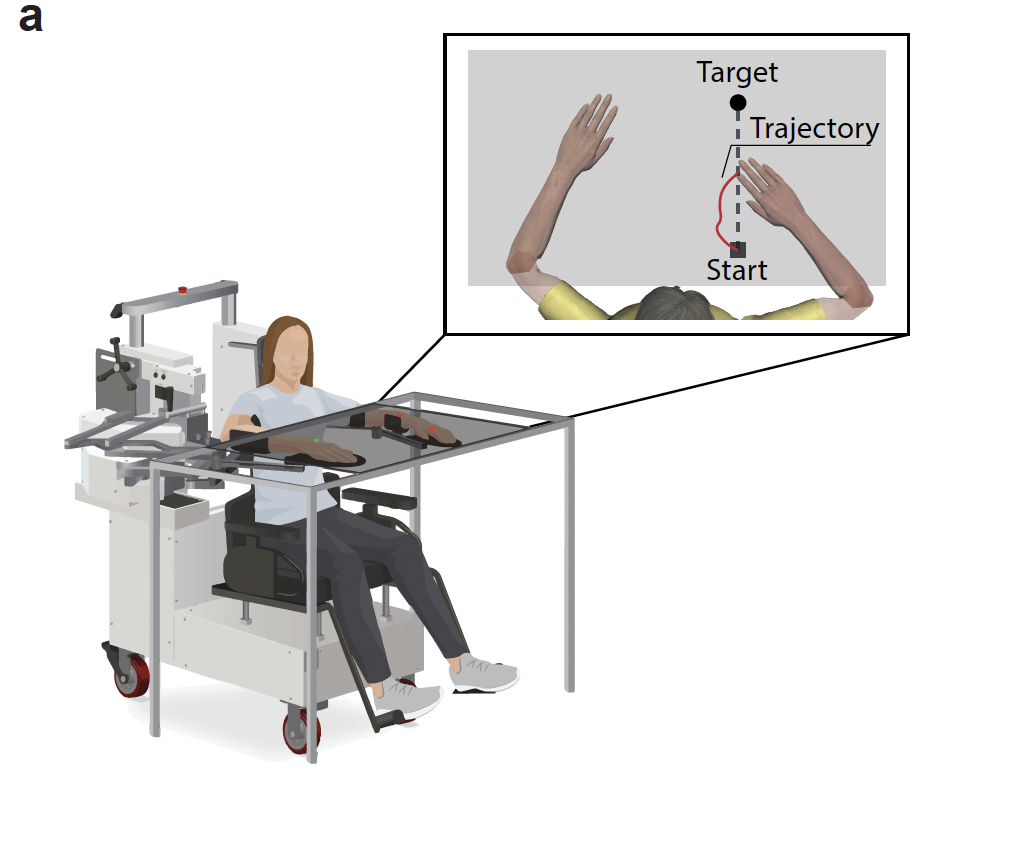
Participants completed repeated tasks reaching to their left, right, and straight ahead
Every voluntary movement depends on carefully coordinated communication between muscles. When one muscle contracts, an opposing one should relax. This process, known as reciprocal inhibition, allows people to reach for a cup of coffee in a smooth and controlled motion. After a stroke, damage to the brain disrupts those signals. Rather than working together, opposing muscles often contract at the same time. We can think of this like trying to drive a car while pressing one foot on the gas and the other on the break. Instead of moving efficiently toward your destination, every movement is slow, jerky, and hard to control.
"For years, the focus has been on using stimulation to strengthen weak muscles. However, stroke survivors often face a dual challenge: muscles that are too weak and muscles that are overactive. Our research proves that targeted spinal cord stimulation can solve both problems simultaneously, rebalancing the nervous system to restore fluid movement,” said Weber.
This study builds on the team’s previous research demonstrating that epidural spinal cord stimulation can immediately improve arm and hand function in people living with chronic stroke. While that work established the potential, the underlying neural mechanism remained a mystery.
By integrating spinal cord stimulation with physical therapy, we expect to significantly enhance patient outcomes, opening new doors for recovery from stroke, spinal cord injury, and beyond.
Doug Weber, Professor, Mechanical Engineering
To investigate, the researchers implanted temporary epidural electrodes over the spinal cord in three people living with chronic post-stroke weakness. Over a 29 day period, participants completed repeated tasks reaching to their left, right, and straight ahead while the team measured arm motion, muscle activity, spinal reflexes and the firing patterns of motor neurons.
When mild electrical stimulation was applied to their spinal cord, participants reached faster and more smoothly. Notably, the opposing muscles showed less activation as well. By recording spiking activity from individual motor neurons, the research team confirmed that spinal cord stimulation directly engaged inhibitory circuits to suppress unwanted muscle activity.
“This discovery was somewhat accidental. We initially expected stimulation to 'turn up' the triceps. Instead, we found something far more significant: the biggest impact was actually reducing overactivity in the biceps,” said Borda. “This revelation fundamentally shifted our strategy from simply strengthening weak muscles to rebalancing the entire neural circuit to restore arm function."
Understanding this mechanism could help researchers optimize future stimulation strategies by targeting specific neural circuits rather than simply increasing muscle activation. This could potentially encourage longer-term recovery when combined with physical therapy in patients recovering from strokes.
“As the first neuromodulation technology to produce immediate improvements in arm movement in people with chronic paralysis, this therapy marks a turning point in stroke recovery,” said Weber. “By integrating spinal cord stimulation with physical therapy, we expect to significantly enhance patient outcomes, opening new doors for recovery from stroke, spinal cord injury, and beyond.”